The Refrigerator Is Louder After Divorce
The quiet after divorce isn't proof you broke your life — and staying busy isn't healing. What the refrigerator hour is actually telling you.
Educational content — see our editorial standards.
 Divorce
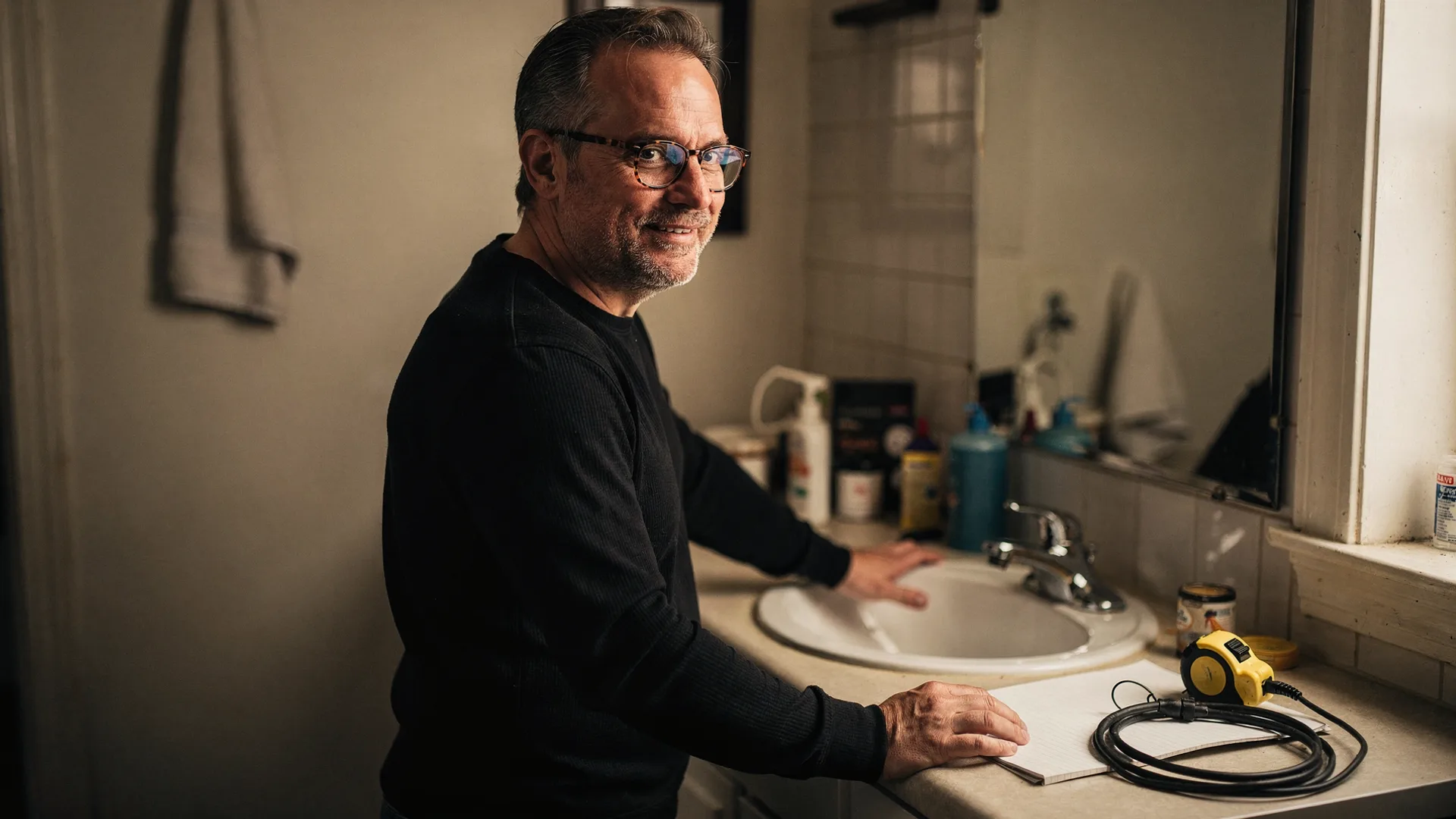
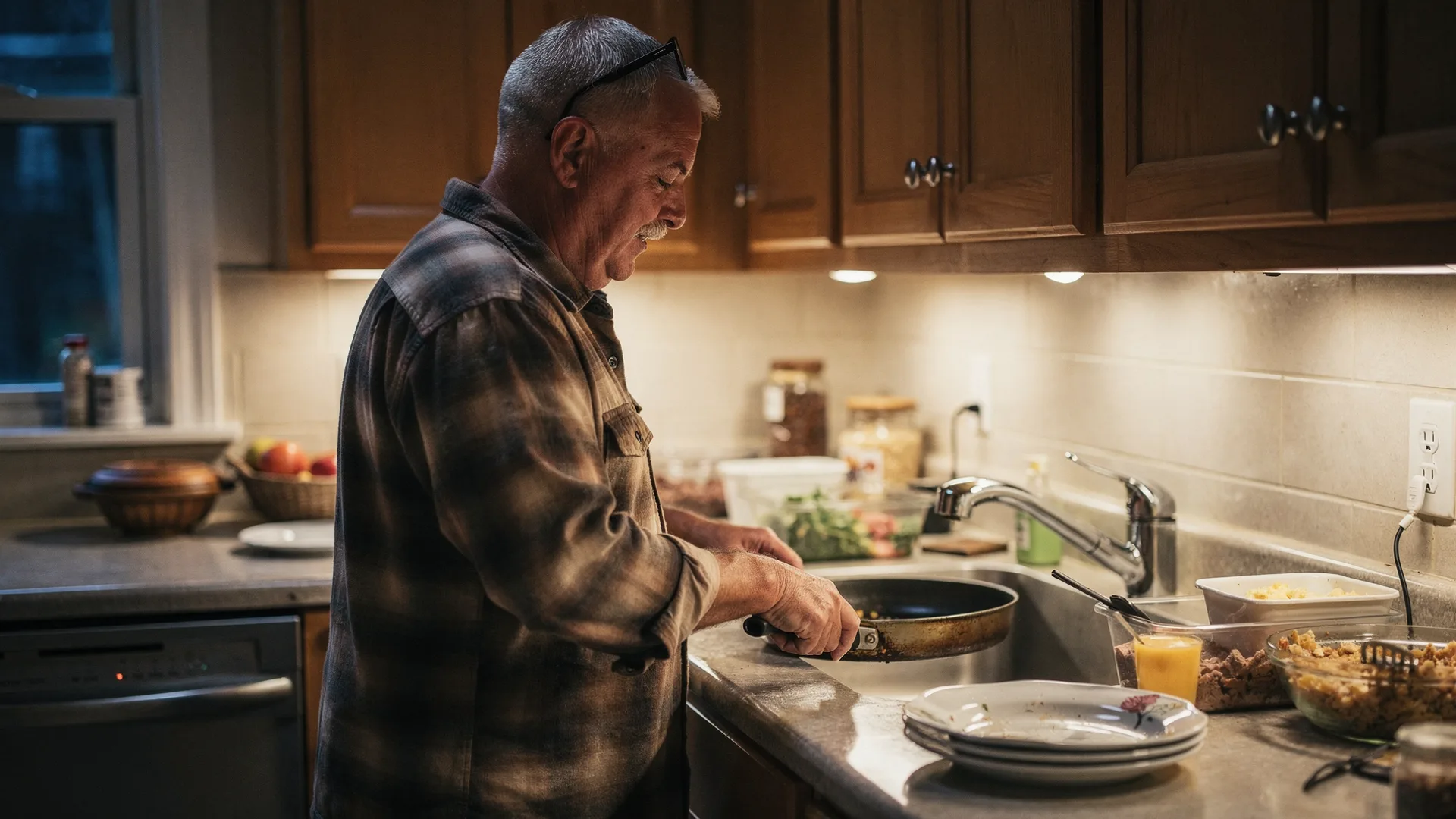
Real shit: it's 11:40 p.m. and you're standing in front of an open refrigerator you're not hungry for, in an apartment you still give directions to like a hotel, and the hum of that machine is the loudest thing you own. You didn't come in here for food. You came in here because the light comes on when you open the door, and for four seconds something in this place reacts to you.
That hum used to be buried. It lived under a dishwasher, a kid's shower running too long, a TV she left on in the other room, the whole ordinary orchestra of a house with people in it. Now it's a solo. Now it's the house band. You stand there in your socks with the cold air on your shins and you realize you have memorized the sound of your own appliance, and something about that fact goes through you like a filleting knife.
Nobody warns you about this part. They warn you about lawyers. They warn you about money. Nobody says: one night you will stand in a kitchen that has never heard your kids laugh, listening to a refrigerator, feeling like a man who got exactly what the paperwork promised and lost everything that wasn't on it.
They also don't warn you about the 1 a.m. version of you — the one who starts typing things into a search bar. Low energy. Testosterone. Peptides. Half-convinced the fix for a quiet house might be sold in a vial. Peptide medicine is real, and further down we'll get precise about what it's actually good at — clinician-prescribed metabolic tools, not grief tools — but if you'd rather start with the sober map than the ad, see what peptide medicine can and can't actually do.
The thing you keep telling people
Out loud, you're doing great. Out loud, it's "honestly, the peace is nice." You say it at work. You say it to your brother. You say it with a little shrug that you have practiced without knowing you were practicing.
And it's not a total lie. The fighting is over. The tension you carried in your jaw for the last three years of the marriage is gone. Nobody sighs at how you load a dishwasher. On paper, this is the calm you said you wanted.
So why does the calm feel like standing in a field after a carnival left? That's the question you don't say at work.
The fear underneath the hum
Here's the thing under the thing, the one that only surfaces at refrigerator hour: you're not just lonely. You're afraid that the happiest version of you was a group project. That the guy who told jokes at dinner, the guy who was easy to be around, the guy your friends actually liked — that he wasn't you. He was a chemical reaction between you and a life that no longer exists, and when the life dissolved, so did he.
That's the fear that makes the quiet unbearable. Not the absence of noise. The suspicion that the noise was load-bearing.
Sit with how much sense that fear makes before you argue with it. You spent fifteen, twenty years becoming a person whose best self had witnesses. Of course the room feels wrong without them. A stage actor doesn't forget his lines when the theater empties — but he does notice there's no reason to say them. That's not brokenness. That's a man whose talents are temporarily unemployed.
The enemy isn't the quiet. It's the schedule you gave it.
Somewhere along the way you absorbed a rule: peace is supposed to feel good immediately. You did the hard thing, you survived the ending, so the reward should have shipped by now. When the quiet feels bad instead, you conclude the problem is you.
That rule is the enemy. It's a lie with excellent marketing.
Peace after divorce is not a beach. It's a construction site at night — the structure is going up, but right now it's rebar and cold concrete and wind, and it looks nothing like the drawing. The feeling of peace arrives months after the fact of peace. Anyone who tells you otherwise is selling a highlight reel of their own recovery with the bad quarters edited out.
The rule has an evil twin: stay busy. Pack the calendar. Say yes to everything. Outrun the refrigerator. And look — motion helps. But busy is not healing, busy is anesthesia with better PR. A man can fill every evening for a year and arrive at the end of it with the exact same silence waiting for him, now with interest. Busy postpones the appointment. It never cancels it.
There's also a distinction worth keeping your thumb on: alone and lonely are not the same animal. Alone is a floor plan. Lonely is a story you're telling about the floor plan — usually the story where the quiet is evidence against you. Married men feel lonely in full houses all the time; they just have more background noise to hide it under. What you're facing isn't a new disease. It's an old feeling with the soundtrack stripped off, and a feeling you can finally hear is a feeling you can finally do something about.
Why does the loneliness hit hardest at night? Because daytime hands you a role to play — worker, dad, guy in line for coffee — and nighttime takes the costume back. Evening is when a married brain expects another voice, so its absence registers like a missing stair. It usually eases as new routines form, but it fades on its own clock, not yours.
The Baseline Audit
Stop guessing what changed.
Ten questions on energy, sleep, weight, libido, recovery, stress, and goals — about three minutes. Then use the read to decide what to raise with a qualified clinician.
Take the Baseline AuditWhat to actually do with the quiet this week
Not a life overhaul. Six moves, sized for a real week.
First, give the evening a spine. The worst hours are 9 p.m. to midnight, so schedule them like meetings: dishes at 9, twenty-minute walk at 9:30, shower, lights out at a fixed time. Boring on purpose. A spine isn't exciting; that's the whole point of a spine.
Second, count your drinks on paper for seven days. No judgment, no quitting speech. Just the honest number, written down. Alcohol at refrigerator hour is the most common way men convert loneliness into worse sleep and a darker Tuesday, and you can't negotiate with a number you refuse to look at.
Third, send one low-stakes text per day. Not "we should catch up sometime," which is a prayer, not a plan. Use this script, word for word: "Tuesday, 7 p.m., that taco place on Fifth. I'm going. Come." Men rebuild social lives on specifics. Vague invitations are how friendships die politely.
Fourth, put one thing in the apartment that says a person lives here. A plant. A framed photo of your kids on an actual wall, not leaning against a baseboard from move-in day. A lamp that isn't on the floor. You're not decorating. You're sending your own nervous system a memo that this address is not a layover.
Fifth, say the true sentence to one human being. Not the shrug. The real one: "The evenings are harder than I expected." Say it to a brother, a friend, a therapist, your doctor. You are not asking to be rescued. You're breaking the silence's monopoly, because silence only wins when it's the only one talking.
Sixth, book the physical you've been dodging. If your sleep is wrecked for more than a month, if food has no taste, if you feel flat in the mornings and can't shake it — that pattern deserves a professional's eyes, not a stoic's endurance. Persistent low mood is a health issue, not a character grade.
Busy postpones the appointment with the quiet. It never cancels it.
Where peptide medicine fits here — and where it doesn't
As promised, the straight version, minus the internet fog. Peptides are short chains of amino acids — your body runs on thousands of them — and "peptide medicine" spans everything from insulin to the newer metabolic drugs. The class earning the attention right now is the GLP-1 family: FDA-approved prescription medicines for type 2 diabetes and, for eligible patients, chronic weight management. That end of the pool is established evidence — large trials, real labels, measurable effects on appetite and blood sugar. From there the water gets murkier fast: compounded versions exist legally in specific circumstances but are not FDA-approved products, and the "research-grade" vials sold online are not medicine for humans at all — they're chemicals with a disclaimer, whatever the checkout page implies. And the claims that pull tired men in at 1 a.m. — energy, mood, motivation, drive — live almost entirely in anecdote territory. Stories, not trials. Interesting stories, sometimes. Still stories.
So here's the honest map for this particular article: no peptide treats loneliness. A quiet apartment is not a metabolic condition, and "sad, tired, and newly alone at 48" is not an indication on any label. If the fatigue or the wrecked sleep hangs on past a month, that's worth a real medical workup — sleep, mood, alcohol, medications, basic labs — because the boring causes are the common ones and most of them are fixable. Knowing precisely what peptides can't do for you is worth more than any vial ever will be.
What better actually looks like
Here's the believable version, not the montage. Three months from now the refrigerator still hums, but you don't hear it, because you're asleep by 11:15 more nights than not. Tacos on Tuesday is now just a thing that happens; you have a usual order and a guy who argues with you about football. The lamp is on a table. Your kids' photo is on the wall, slightly crooked, and it stays that way because your daughter hung it. The quiet is still quiet — but it's the quiet of a place that's yours, not a place you're serving a sentence in.
The happiest version of you wasn't a group project. He was the guy who built the group. He can do it again with different materials, on a different lot, slower than you'd like. Builders don't need applause to pour a foundation. They just pour it.
And one more thing, because it's true and nobody says it: some nights will still ambush you. A song, a smell, a kid-sized sock behind the dryer. Recovery isn't the absence of those hits. It's the shrinking gap between the hit and the moment you're okay again — a gap that closes so gradually you'll only notice it in the rearview, some ordinary Tuesday, standing in a kitchen that finally just sounds like a kitchen.
One rule to carry out of here, stated once and meant completely: research products are not for self-treatment. Curiosity is free. Experimenting on yourself with a mystery vial during the worst year of your life is not.
Sources
- Grief — MedlinePlus (NIH)
- Depression — National Institute of Mental Health
- Alcohol Use and Your Health — CDC
- Healthy Sleep Habits — Sleep Foundation
This article is educational and is not medical advice. If you are dealing with libido changes, ED, blood sugar concerns, hair loss, weight gain, pain, or recovery issues, talk with a qualified clinician before starting any treatment. See our editorial standards.
Byline
Mason Reed
Senior Editor, Second Acts
Writes about divorce, fatherhood, rebuilding confidence, and the emotional mechanics of starting over after 40.
More from Mason Reed →The Second Half Brief
More on divorce, weekly.
One raw email a week — no spam, no miracle claims. Or see what the Brief is.
Write to us
Letters from the Bench
Been through a version of this? Reply with your story and we may run it in a future Letters from the Bench feature. Nothing gets published without your explicit permission, and anything we run is anonymized.
Send your story