The Sunday Night Problem
All weekend you were Dad. Then the door closed. Now you are just a man with leftovers and silence.
Educational content — see our editorial standards.
 Divorce
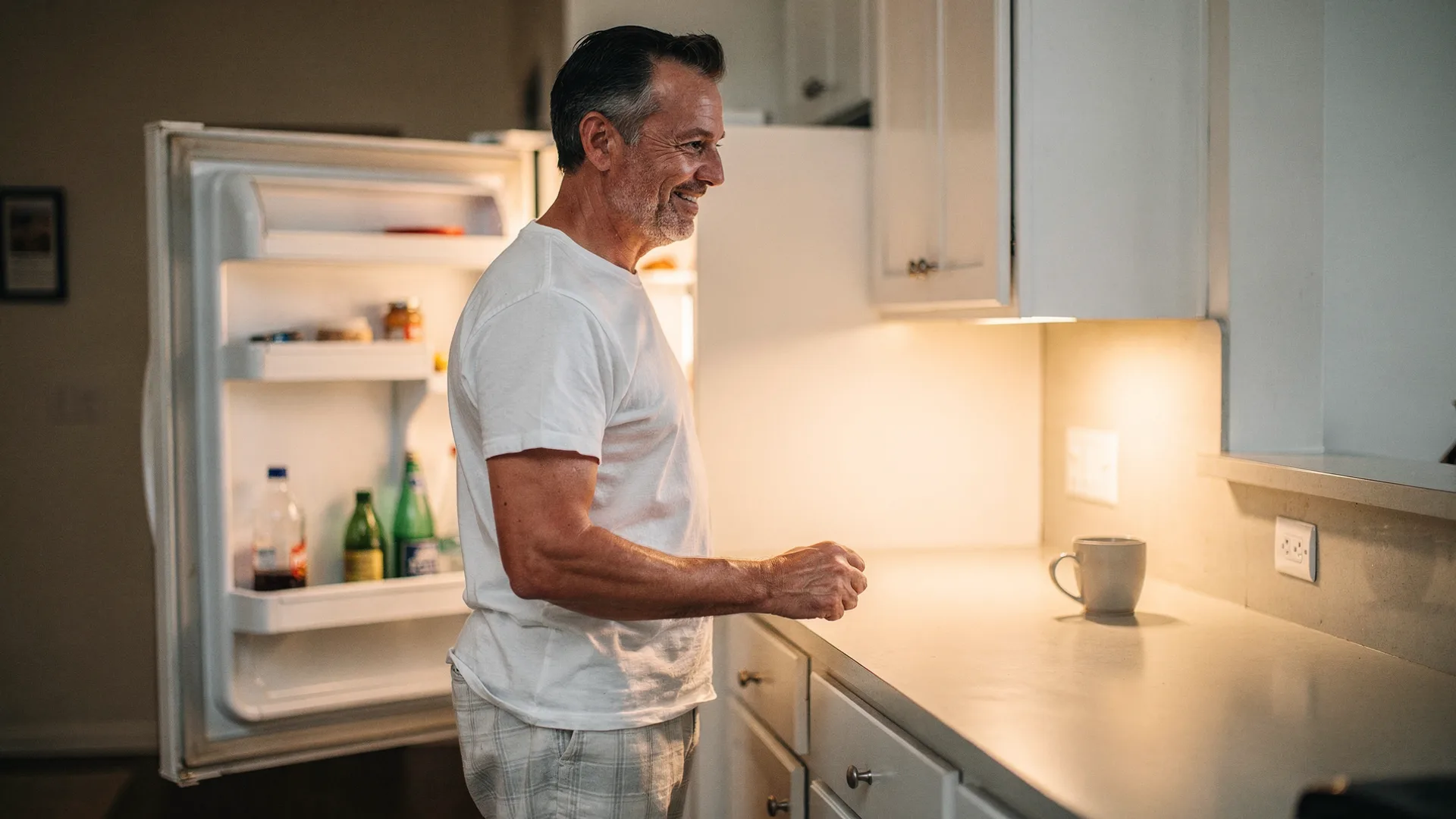
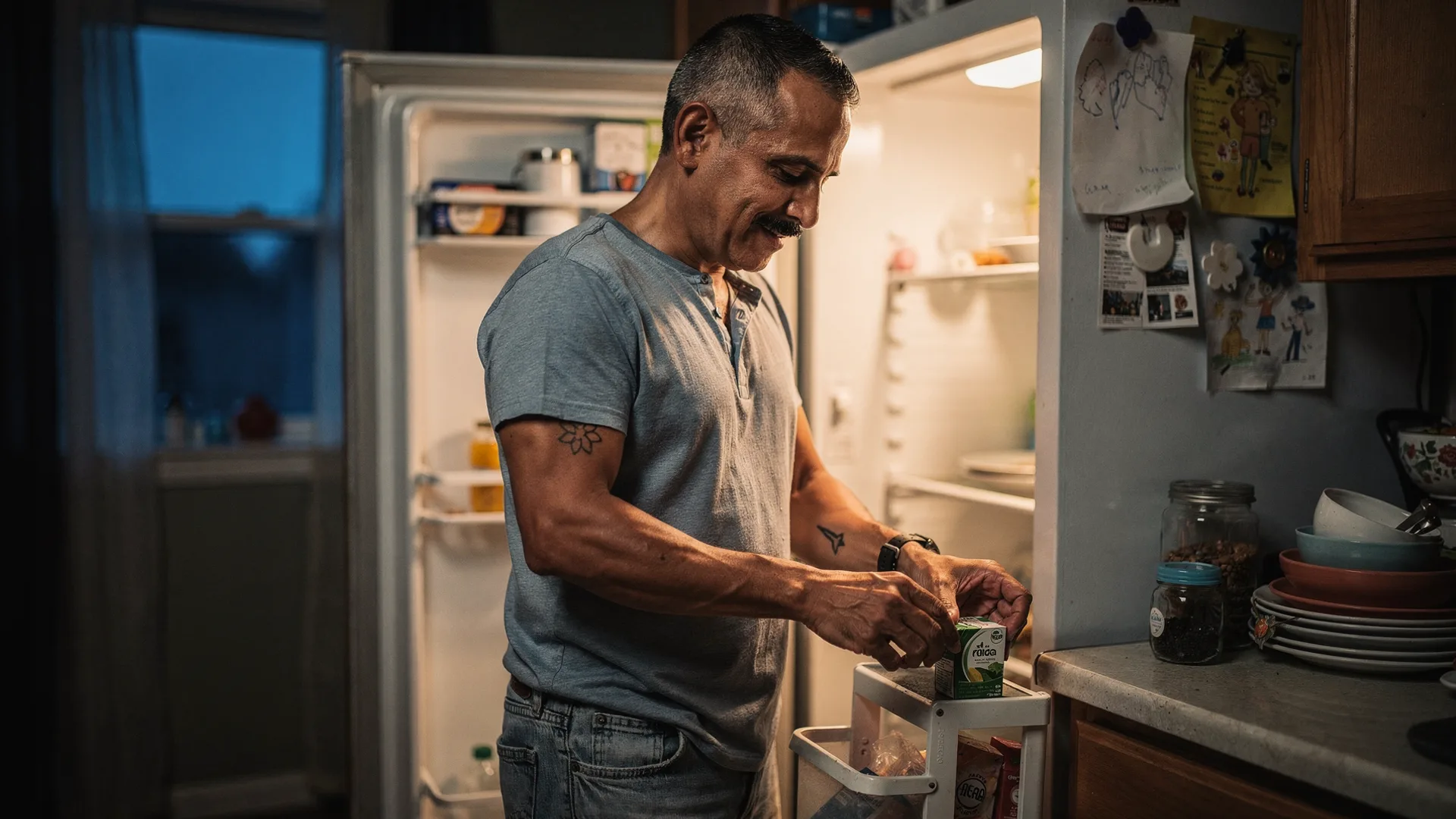
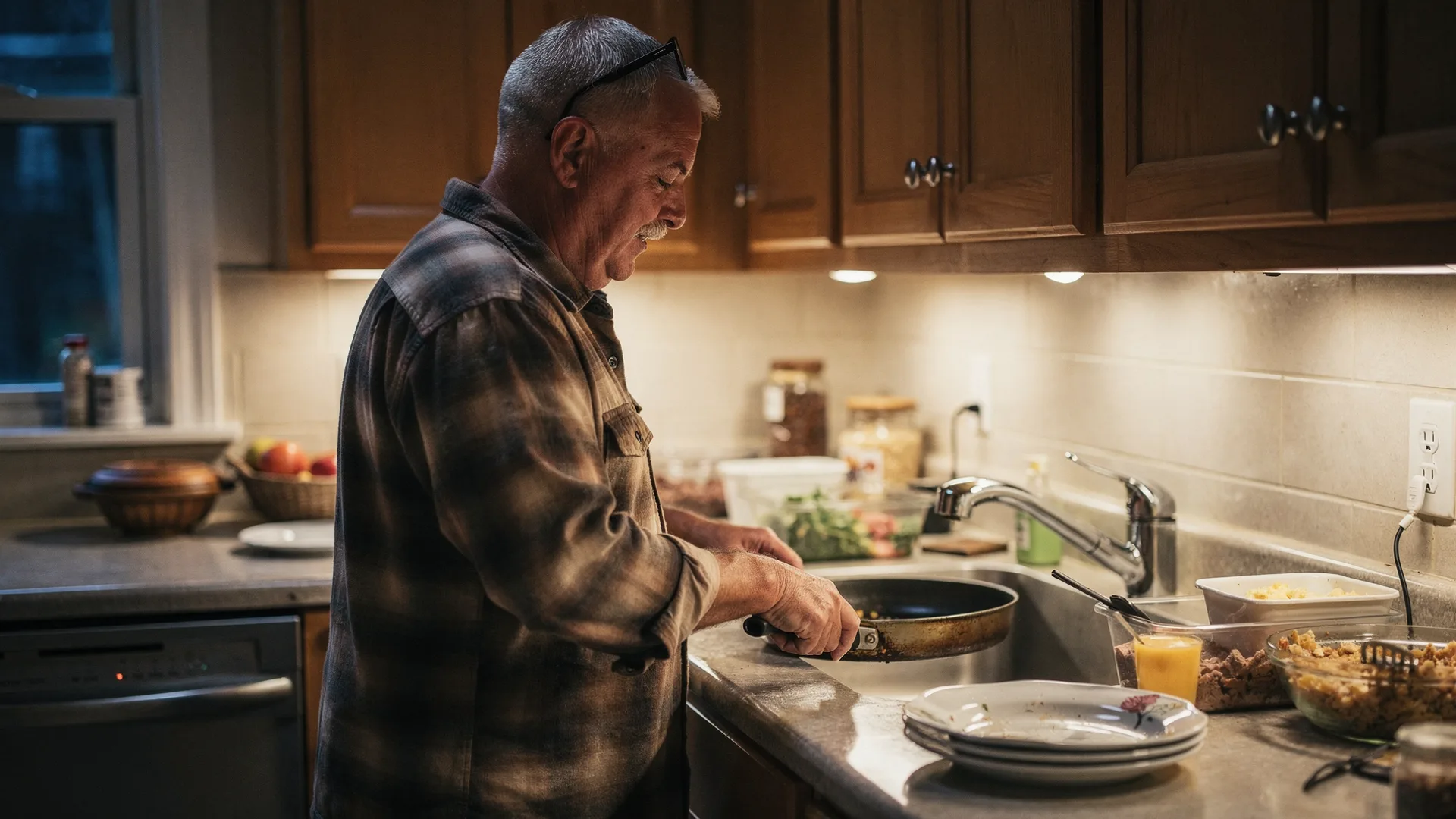
Real shit: Sunday night after the kids leave can turn a normal kitchen into a psychological crime scene. Two hours ago this room was a circus — spilled cereal, someone narrating a video game, a backpack search-and-rescue for a missing shoe. Now it is 7:15, the dishwasher is running, and you are standing at the counter eating leftover mac and cheese out of the pan, because plating it for one felt like too much to survive.
Nothing bad is happening. That is the strange part. No fight, no crisis, just a man, a pan, and a quiet that has weight to it. And yet Sunday night can flatten a guy who handled the entire weekend without blinking.
The identity crash when the door closes
All weekend you had a job with a name. You were Dad — cook, referee, driver, the guy who knows where the good scissors are. Then the door closes on Sunday and the job ends mid-sentence. Your body is still running the Dad program, still scanning for the next need, and there is no one left to need you. That gap, between the role still running and the room gone empty, is the whole ache.
It is not that you cannot be alone. It is that you were just at maximum usefulness and got switched off without a landing. Purpose does not turn off clean. It sputters, and the sputter feels like grief.
What makes Sunday specifically worse than a random Tuesday is the drop height. On a normal night alone you were already at ground level; there is nowhere to fall. On Sunday you spent two or three days at altitude — needed, loud, useful, the center of a small loud world — and then the door closes and you go from that to a pan of mac and cheese in about ninety seconds. It is not the loneliness that levels you. It is the speed of the descent.
The Baseline Audit
Stop guessing what changed.
Ten questions on energy, sleep, weight, libido, recovery, stress, and goals — about three minutes. Then use the read to decide what to raise with a qualified clinician.
Take the Baseline AuditDo not fill the silence with anesthesia
Sunday night is when the bad defaults come to collect. The bottle that turns a two-hour ache into a foggy stretch you pay for with a wrecked Monday. The scroll through her feed. The couch you sink into at 7:30 and do not leave until you sleepwalk to bed at midnight feeling worse than when you sat down. Each one promises to fill the silence. Each one just deadens you and hands you the bill on Monday.
The goal is not to stop missing them. The goal is to stop abandoning yourself when they leave.
That is the reframe. Missing your kids is not a wound to numb — it is the correct response of a man who loves his children, and you would not trade it. The problem is not the missing. The problem is what you do to yourself inside it. You would never abandon your kid on a hard night. Stop doing it to the man in the kitchen.
And clock the cost of the anesthesia honestly, because it does not stay on Sunday. A wine-heavy Sunday steals your Monday — the fog, the short fuse, the workout you skip, the eating that goes sideways by noon. So one bad night becomes a bad week, and a run of bad weeks becomes the guy your kids come back to on Wednesday: dulled, thicker, a little further away. The Sunday you numb is not free. It bills the whole household, in installments, all week long.
Build a Sunday reset protocol
Beat Sunday night by scripting it before it arrives, because a plan made Wednesday is stronger than willpower summoned at 7:15 with a pan in your hand. Same sequence every week. When the door closes, you move — a walk, the gym, anything that gets the heart rate up and burns off the switched-off chemistry instead of marinating in it on the couch.
Then you point the evening at Monday instead of at the past. Lay out the week. Prep a real meal so you are not eating grief out of a pan. Set out gym clothes. Text the one friend who also drives home to an empty place on Sundays. You are not filling the silence — you are giving it a shape, a rhythm your nervous system can lean on when the room goes quiet.
Make it the same every week, on purpose, so it runs without a vote. The power of a protocol is that it does not care how you feel — you do not have to want the walk, you just have to have already decided that the walk is what happens when the door closes. Motivation shows up late and unreliable, especially on Sunday. A decision you made on Wednesday shows up on time. Build the thing once, then just obey the man who built it.
Use the pain as a signal, not a sentence
The Sunday ache is information. It is telling you that you love hard and that you have not yet built a life sturdy enough to hold you on the off-nights. Both of those are workable. One is a gift. The other is a project — a body, a circle, a purpose that exists even when the kids are at their mom's.
If the Sunday low stops being a few rough hours and becomes a heaviness that swallows the whole week, do not tough it out on principle. That is a signal to get your baseline and talk to a qualified clinician about your sleep, your stress, and your mood. Shame burns hot and leaves ash. A protocol is still standing next Sunday when the door closes again. The kids will notice the difference in the man who greets them Wednesday, even if they never know why.
This article is educational and is not medical advice. If you are dealing with libido changes, ED, blood sugar concerns, hair loss, weight gain, pain, or recovery issues, talk with a qualified clinician before starting any treatment. See our editorial standards.
Byline
Mason Reed
Senior Editor, Second Acts
Writes about divorce, fatherhood, rebuilding confidence, and the emotional mechanics of starting over after 40.
More from Mason Reed →The Second Half Brief
More on divorce, weekly.
One raw email a week — no spam, no miracle claims. Or see what the Brief is.
Write to us
Letters from the Bench
Been through a version of this? Reply with your story and we may run it in a future Letters from the Bench feature. Nothing gets published without your explicit permission, and anything we run is anonymized.
Send your story