The Quiet House After Drop-Off
The worst sound after divorce is not yelling. It is the refrigerator humming in a house where your kids' noise used to live.
Educational content — see our editorial standards.
 Divorce
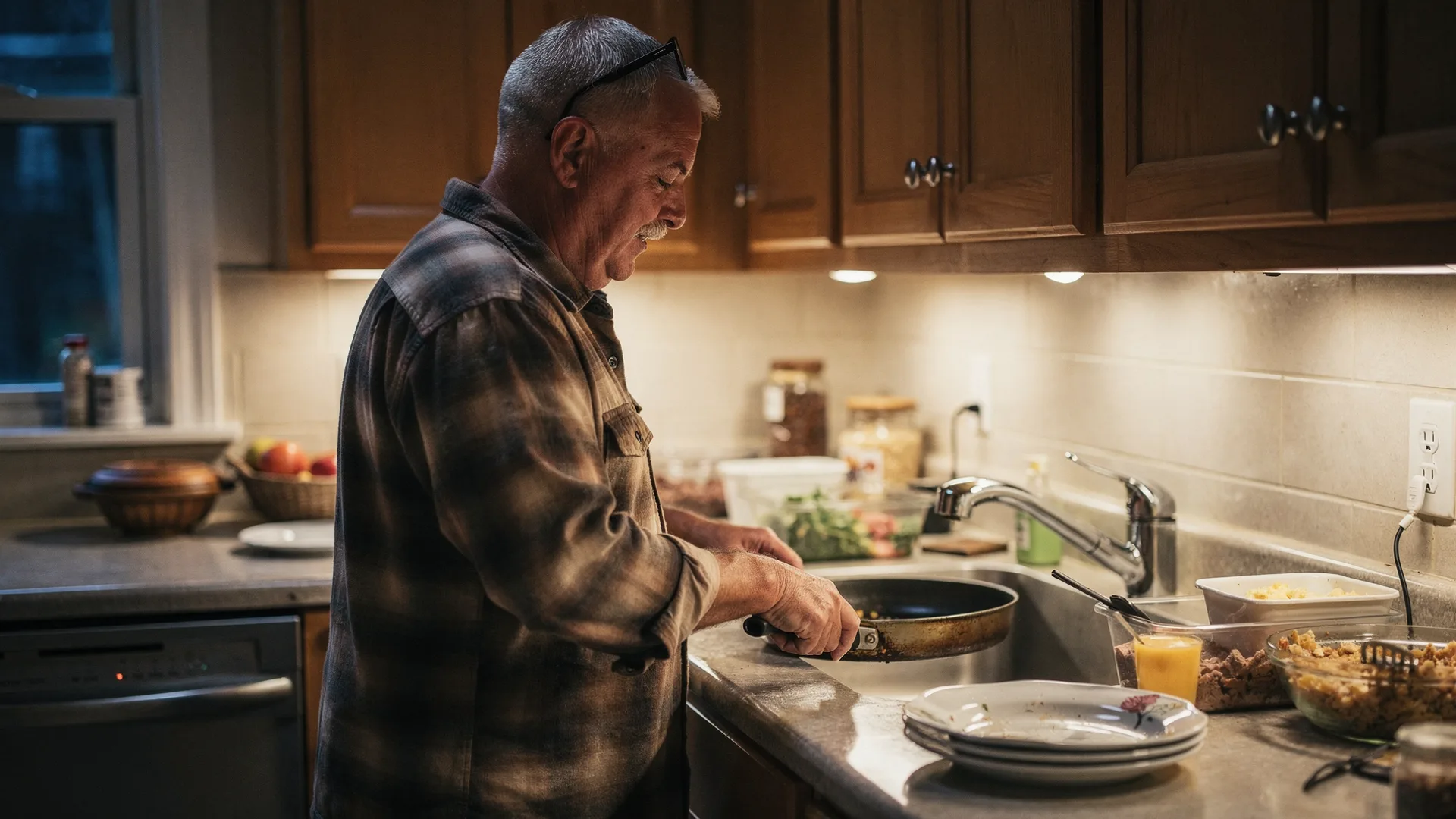
Real shit: the first hour after drop-off can make a grown man feel haunted by a juice box. You close the car door, you drive home, you walk in, and the house does a thing houses are not supposed to do. It gets loud by being silent. The fridge hums. The clock you never noticed ticks. And on the counter there is a juice box, half-crushed, straw still in it, that no one is coming back for tonight.
That juice box has more emotional voltage than anything your lawyer ever said. Because it is proof. Four hours ago this place had noise, and now it has a hum, and you are the only one here to hear the difference.
The handoff hangover
There is a specific crash that hits about forty minutes after you hand them over. Call it the handoff hangover. You spent the whole custody stretch on — dialed up, fun, refereeing, cooking, being the entire staff of a small hotel. Then the door closes and your nervous system, which was flooded with purpose, suddenly has nowhere to send it. That is not weakness. That is a body coming down off a job it was built for.
Men misread this crash as loneliness or failure. It is neither. It is withdrawal. You were metabolizing love at a high rate for three days, and the supply just left in a car seat.
The tell is how physical it is. Your chest actually feels it. Your hands do not know what to do. You open the fridge for no reason and close it. You pick up your phone and put it down. That is not you being pathetic — that is a body that spent a weekend at full output suddenly idling in a driveway with the engine still warm and nowhere left to drive.
The Baseline Audit
Stop guessing what changed.
Ten questions on energy, sleep, weight, libido, recovery, stress, and goals — about three minutes. Then use the read to decide what to raise with a qualified clinician.
Take the Baseline AuditWhy the mess becomes evidence
You will notice you cannot clean up right away. The crumbs on the counter, the socks by the couch, the toothpaste snake in the sink — you leave it. And you tell yourself you are lazy or sad. You are not. You are staging a crime scene in reverse. The mess is the last physical evidence that they were here, that this is real, that you are still a father in a house and not just a guy in an apartment.
The silence is not proof you failed. It is proof your nervous system has nowhere to put the love.
Understand what that sentence does. It takes the ache and reclassifies it. The ache is not a verdict on your worth as a man. It is unspent fuel. You have love with the tank full and the engine off. The job is not to feel less. The job is to build somewhere for that fuel to go before it turns on you.
Because unspent, it does turn on you. Love with nowhere to go does not evaporate; it sours into rumination — replaying the marriage, auditing the custody split, building the case you will never get to argue. That is the same fuel, just pointed backward at a courtroom that already closed. Same energy, worse address. The whole game after drop-off is aiming it forward before it finds the past on its own.
The dangerous stretch
The dangerous window is 9 p.m. to midnight of that first quiet night. That is when the fridge hum gets loudest and the easy answers come knocking — the fourth drink, the two-hour scroll through her new life, the 1 a.m. text you will hate at 8. None of those are relaxation. They are anesthesia, and anesthesia is just pain on a payment plan. You feel less tonight and worse for three days.
Name the window so you can see it coming. Withdrawal peaks and then it passes, every single time, whether you feed it or not. Knowing that is a tool. The hum does not last. You just have to not make a decision inside it.
Put a number on it so it stops feeling infinite. The acute wave — the part where the silence has actual teeth — usually runs about ninety minutes. Not the whole night. Ninety minutes. If you can get yourself across that stretch without reaching for the anesthesia, you come out the other side into an evening that is just quiet, not haunted. The trick is having something to do with your hands and your feet for that hour and a half.
Build the ritual that catches you
Do not white-knuckle the empty night. Build a landing pattern. The second the door closes, you run a fixed sequence — put the juice box in the recycling, wipe the one counter, change into gym clothes, walk out the front door for exactly twenty minutes even if it is dark and you do not feel like it. Movement burns off the withdrawal chemistry faster than sitting ever will.
Then give the fuel a real destination on a repeatable schedule: the gym, a workout you actually track, a standing call with the friend who also drives home to a hum, an hour on something you are building. If the sleep stays broken and the low stays heavy for weeks, that is a signal to get a baseline and talk to a qualified clinician instead of self-medicating in the kitchen. Shame burns hot and leaves ash. A ritual is still there next Sunday when the door closes again.
And keep the juice box, in a sense. Not the literal box — the meaning of it. The evidence that a few hours ago this quiet place was full because of you, that you are a father whether they are asleep down the hall or asleep across town. The hum in the walls is not proof of what you lost. It is the sound of a house waiting for the door to open again, and it will.
This article is educational and is not medical advice. If you are dealing with libido changes, ED, blood sugar concerns, hair loss, weight gain, pain, or recovery issues, talk with a qualified clinician before starting any treatment. See our editorial standards.
Byline
Mason Reed
Senior Editor, Second Acts
Writes about divorce, fatherhood, rebuilding confidence, and the emotional mechanics of starting over after 40.
More from Mason Reed →The Second Half Brief
More on divorce, weekly.
One raw email a week — no spam, no miracle claims. Or see what the Brief is.
Write to us
Letters from the Bench
Been through a version of this? Reply with your story and we may run it in a future Letters from the Bench feature. Nothing gets published without your explicit permission, and anything we run is anonymized.
Send your story