Loose Skin: The Victory Scar That Still Makes You Hide
You did the work and the skin stayed. What loose skin after major weight loss really means, what improves it, and how to weigh surgery calmly.
Educational content — see our editorial standards.
 Body
BodyReal shit: it's 6 a.m. at a hotel pool in a city you don't live in, and you checked the deck twice before you took your shirt off. Once from the doorway, once from the chair. Empty. Just you, the chlorine smell, and a lifeguard stand with nobody in it. And you still fold the shirt within arm's reach of the ladder, and you still get in fast, like the water is a getaway car. Ninety pounds gone — ninety — and you swim at dawn in an empty pool like a man hiding something he earned.
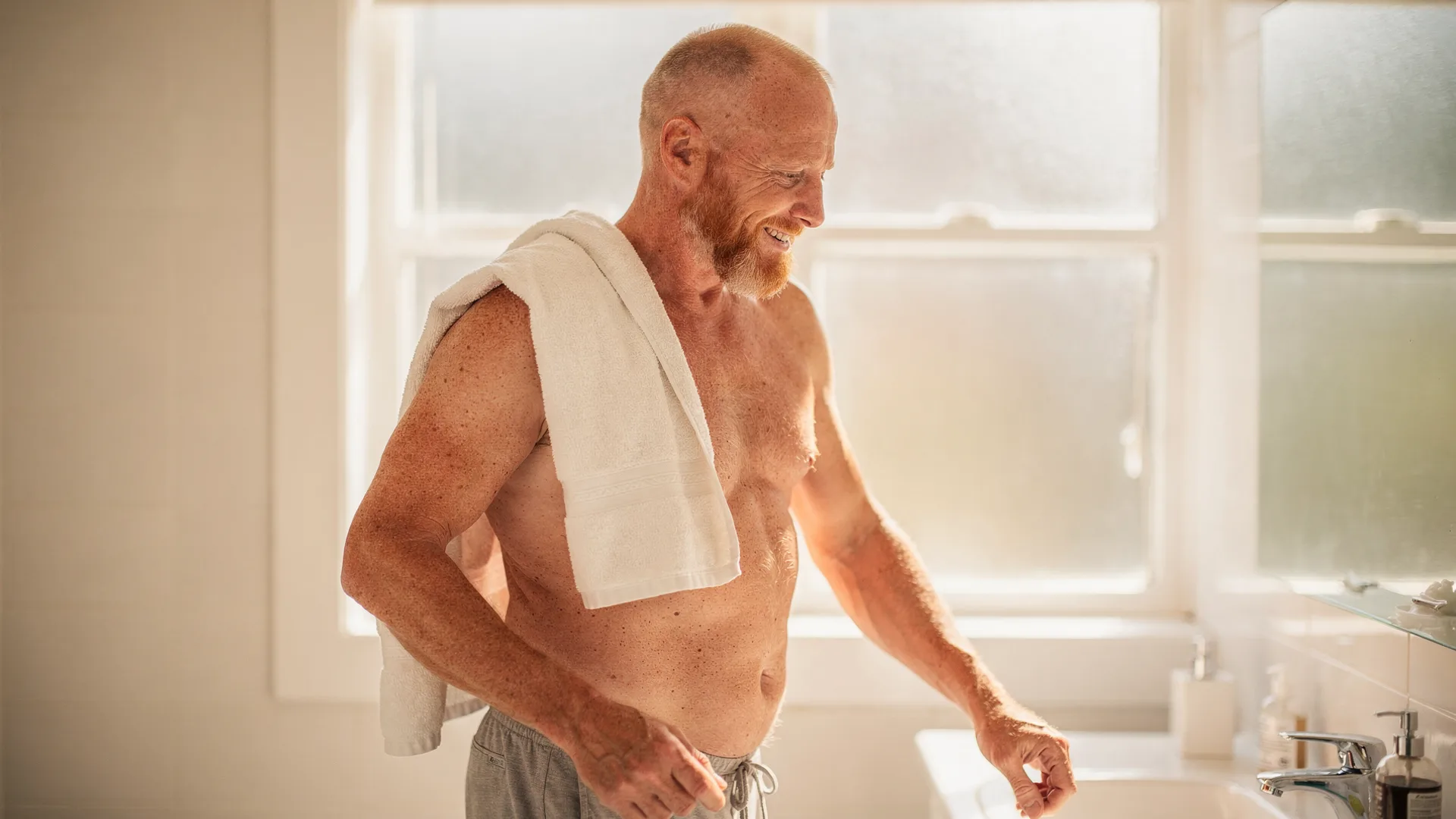
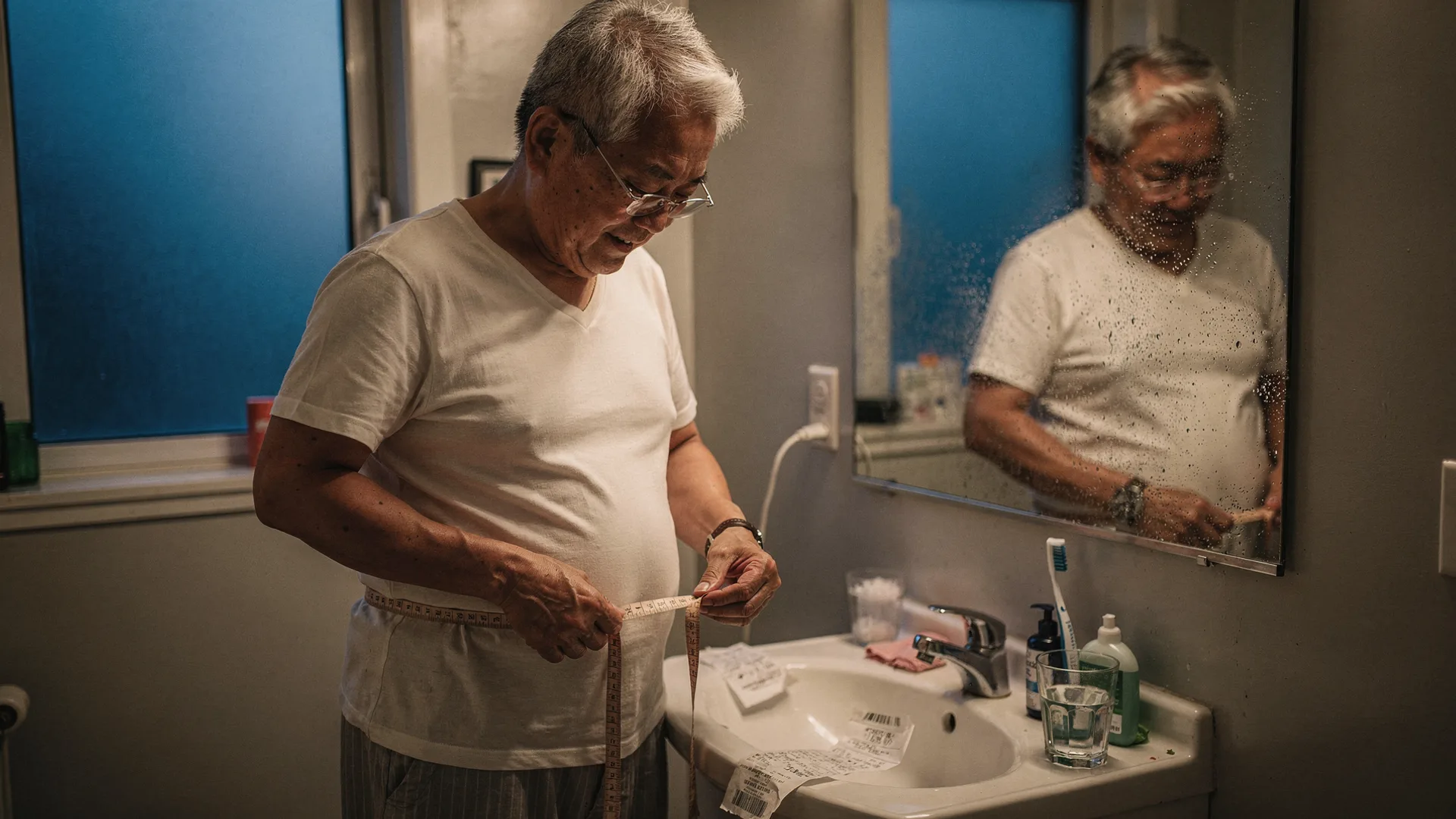
That's the joke nobody laughs at. You did the impossible thing. And the mirror handed you a receipt you didn't agree to: the skin stayed. Around the middle, under the arms, the places only you and the bathroom light know about. The weight left. The evidence didn't.
You're allowed to say it's unfair. It is unfair. You paid the toll and the road kept a piece of you anyway.
And let's kill one search result before it wastes another night of your life: no injection — FDA-approved, compounded, or gray-market vial with 'research' on the label — changes skin that has already stretched. The peptide question has a short, honest answer coming later in this piece. If you want the wider lay of the land first, here's where peptide medicine actually stands — but the skin conversation is about tissue, time, and sometimes a surgeon. Not a syringe.
The thing you say, and the thing you mean
Out loud: it's just extra skin. Whatever. Small price.
And most days you almost believe it. But that's not what you're thinking at the pool at 6 a.m. What you're thinking is closer to this: I did everything right and I still don't get to be normal. The contract you signed in your head was simple — do the brutal work, get freedom from the shame. You held up your end. And the skin feels like the fine print nobody read to you, a permanent watermark of the before, proof on your own body that you once let it get that bad.
So the shirt stays on at the lake. You shower fast and dress faster at the gym you conquered. The strongest year of your life produced a body you handle like a secret.
The after photo was cropped
Here's your enemy, and it isn't your skin. It's the crop tool.
Every transformation photo you've ever seen was framed by someone with an incentive: good light, good angle, shirt strategically on or arms strategically raised, and the loose skin either surgically gone, genetically absent, or edited out of the story. The comment sections don't discuss it. The programs don't mention it in the sales page. So each man who arrives at the finish line with skin his effort couldn't shrink concludes, privately, that he did it wrong — too slow, too fast, too old, too weak.
The silence isn't protecting you. It's isolating you. Skin is tissue, not fabric; after years stretched over a much larger frame, its ability to snap back depends on things you never chose — how much was lost, how quickly, your age, your genes, how long the skin carried the load. A twenty-six-year-old who drops forty pounds and a fifty-one-year-old who drops a hundred are playing two different games, and the culture shows you exactly one of them. The crop tool erased that truth and left every honest body looking like a mistake.
Notice what that silence has been costing you, specifically. Not the beach — the ordinary stuff. The gym locker room you time like a bank job. The maybe-next-time you've said to the lake trip three summers running. The way you undress in the dark in your own house. Add it up and the skin isn't the expensive part. The hiding is.
The Baseline Audit
Stop guessing what changed.
Ten questions on energy, sleep, weight, libido, recovery, stress, and goals — about three minutes. Then use the read to decide what to raise with a qualified clinician.
Take the Baseline AuditDoes loose skin go away after major weight loss? Sometimes it improves over months as weight stabilizes, especially after smaller losses — but after very large weight loss, skin often does not fully retract on its own. Real options include time and weight stability, strength training, skin care for irritation, and consultation with a dermatologist or board-certified plastic surgeon about body-contouring procedures.
The reframe: it's a scar, and scars outrank shame
Try this on, because it's more accurate than the watermark story: the skin is a scar in the oldest, most honorable sense — the mark tissue keeps when it survives something big. Nobody looks at a lineman's knee scar and reads failure. The skin around your middle is the same category of object. It is not evidence that you were weak. It is evidence of the size of the thing you beat.
That doesn't mean you have to love it, frame it, or post it. You're allowed to want it gone; wanting a scar revised is not self-hatred. But shame and strategy can't hold the same pen. Put the shame down first. Then decide, like an adult with options, what you want to do about the tissue.
What to actually do about it
Seven lanes, in order of regret-proofing.
Give it a stability year. Skin does its best retracting when your weight has been steady — and surgeons generally want a stable weight before they'll operate anyway. If you're within a year of goal, the smartest move is often patience with a calendar date on it: I decide next June, not tonight.
Train like the frame matters. Strength work fills some of the space the fat vacated and changes how skin sits on the body. It won't erase folds, and anyone promising that is selling something — but two or three sessions a week reshapes the silhouette and, more importantly, rebuilds the deal between you and your body: it works for you now.
Treat skin problems as medical, not cosmetic. Chafing, rashes, or recurring irritation under folds is a clinical issue — see a clinician, and keep a simple log of flare-ups with dates and photos. Documented, persistent skin problems can matter later in medical and coverage conversations about skin-removal procedures.
Take the consultation you keep not booking. A consult with a board-certified plastic surgeon is information, not commitment. Bring three questions, word for word: 'Given my age, skin, and weight history, what would a realistic result look like?' — 'What are the scars, the recovery, and the ways this goes wrong?' — 'If I do nothing, what changes and what doesn't?' You will leave with facts where the 2 a.m. guessing used to live.
Dress for the body you have, not the one you're hiding. In the meantime — and there is a meantime, whether you choose surgery, training, or patience — buy clothes that fit the current frame instead of draping the old one's tents over it. A fitted shirt over loose skin looks like a fit man. A tent looks like a tent. If workouts are where the skin bothers you most, snug athletic layers exist for exactly this reason, and using them isn't hiding; it's comfort while you work.
Run the pool protocol. Exposure in steps, on your terms: the empty pool with no shirt was step one, and you already did it. Step two is staying in the water when the second swimmer shows up. Step three is the busy pool with your kid, where you discover the brutal, liberating truth — nobody is studying your torso, because everyone is busy hiding their own something.
Let one person see it on purpose. If someone shares your bed or your bathroom sink, they've already seen more than you think — and the hiding routine is teaching them a story about themselves, not just about you. A partner tends to read your flinch as distance, not shame. One sentence in your own kitchen fixes more than a year of dark-room undressing: 'The skin thing — it bothers me more than I let on. I'm not hiding from you. I'm working on it.' That's the whole speech. Shame that has been said out loud to one safe person loses its authority everywhere else.
Shame and strategy cannot hold the same pen. Put the shame down first.
The peptide question, answered straight
You've seen the ads by now — compounds promising to tighten, firm, or renew skin after weight loss. Here is the fact, stated like one: no peptide removes or meaningfully tightens loose skin after major weight loss. Not the FDA-approved incretin medicines, which address weight and blood sugar and did their job admirably; not compounded copies, which are not FDA-approved products; not research-use vials, which are not medicine at all. Skin that spent years stretched does not respond to a molecule. Anyone marketing a skin-tightening peptide for your situation is monetizing your 6 a.m. pool routine.
The levers that are real: weight stability and time, which give skin its best natural case. Resistance training, which changes how the tissue sits on the frame. Dermatologic care when folds get irritated. And for skin that will never retract on its own, a body-contouring surgery consult — the one conversation in this list where a clinician's exam actually decides something. Mental-health support belongs on the list too, for when the shame outweighs the skin. That's the whole toolbox. Nothing in it comes from a vial.
Next summer, at the loud pool
Here's the believable version, no montage music. Next summer, a public pool, kids doing cannonballs, somebody's speaker playing something terrible. You take your shirt off at the chair — at the chair, not at the water's edge after a final scan — and you get in. The skin comes with you. Nobody gasps. A kid asks you to judge a splash contest. Water, noise, sunscreen, an ordinary afternoon that the before-body version of you would have watched from a parked car with the AC running.
The skin may still be there. The hiding doesn't have to be. Those were never the same thing — the crop tool just taught you they were, and you're done taking its word for it.
Learn before you leap
If you're researching what peptide compounds can and cannot do, get your information from documentation rather than marketing — including the limits, which in your case are the whole story. Research products are not for self-treatment, and no webpage replaces a surgeon, dermatologist, or clinician who can examine the actual you.
Sources
- Body Contouring — American Society of Plastic Surgeons
- Public Resource Center — American Academy of Dermatology
- Weight Management — NIDDK (NIH)
- Obesity health topic — MedlinePlus (NIH)
This article is educational and is not medical advice. If you are dealing with libido changes, ED, blood sugar concerns, hair loss, weight gain, pain, or recovery issues, talk with a qualified clinician before starting any treatment. See our editorial standards.
Byline
Dean Calder
Body & Recovery Editor
Covers strength, recovery, injury identity, belly fat, sleep, and the physical reset men face in midlife.
More from Dean Calder →The Second Half Brief
More on body, weekly.
One raw email a week — no spam, no miracle claims. Or see what the Brief is.
Write to us
Letters from the Bench
Been through a version of this? Reply with your story and we may run it in a future Letters from the Bench feature. Nothing gets published without your explicit permission, and anything we run is anonymized.
Send your story