I Lost 100 Pounds and the Old Man Is Still in the Mirror
You lost the weight and still see the old man in the mirror. Body-image lag after major weight loss is real — here's why it happens and what helps.
Educational content — see our editorial standards.
 Body
BodyReal shit: you carried the 2XL into the fitting room out of pure muscle memory. Grabbed it off the rack the way you grab your keys — no thought, twenty years of practice in one reach. Then, on a dare to yourself, you grabbed the medium too. And now you're standing in a fluorescent-lit stall, wearing the dare, and it fits. It buttons without negotiation. It hangs right. You're holding both shirts like evidence in a trial you don't believe you won, staring at a stranger who apparently has your face and your receipts.
You did the thing. A hundred pounds, gone. Your knees stopped filing complaints. People who haven't seen you in a year do the double-take, the too-long pause, the hand on your shoulder.
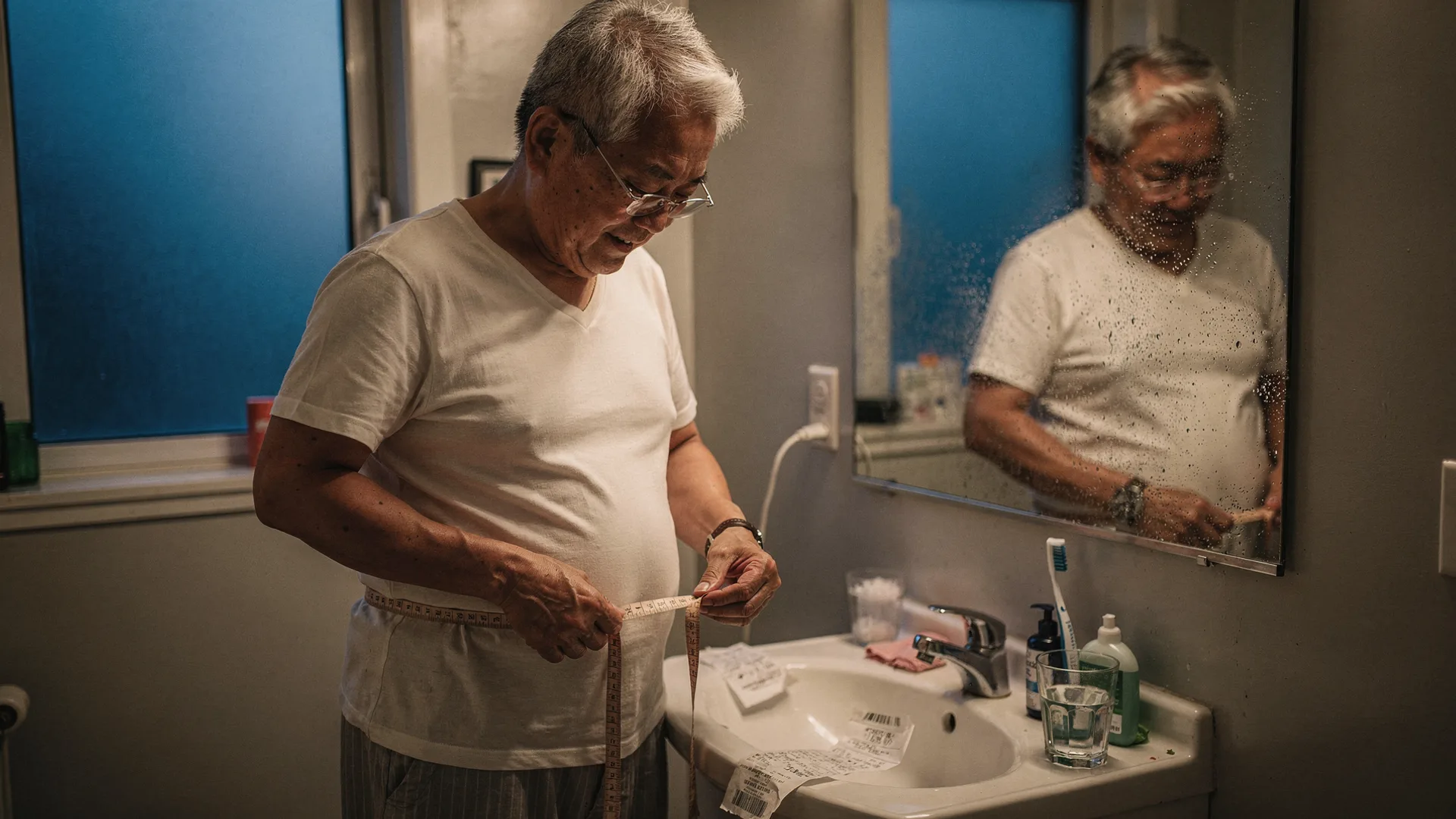
And the guy in the mirror still walks like he's apologizing for the space.
Nobody put this part in the brochure: body image after major weight loss does not move at the speed of the scale. The body finished the assignment months ago. The head is still sitting in the old classroom, taking notes for a test that got canceled.
And it doesn't matter how the weight left. Surgery, two years of brute-force consistency, or one of the GLP-1 prescriptions that finally made the biology negotiable — the mirror lag arrives on the same schedule for all of them. The peptide-based medicines changed your appetite and your bloodwork; they never claimed jurisdiction over your reflection. If you're still sorting out where peptide-based weight medicine actually stands, that's worth understanding on its own terms — but it will not explain the stranger in the fitting room. Nothing in a vial does.
The thing you say out loud — and the thing under it
Out loud, you keep it casual. Still getting used to it. I don't really see it yet. You deflect the compliments with a joke, because the joke is a shorter conversation than the truth.
The truth is stranger and heavier. You still turn sideways through gaps that no longer require it. You still brace before chairs with arms. You still scan every room for the sturdy seat, the aisle spot, the exit from other people's attention. The big man had procedures, and the procedures are still running like an alarm system in a house you sold.
And under that, the real trench: the old body wasn't just a body. It was a job. You were the big guy — the funny one, the strong one, the one who took up space so nobody would look too closely at him. That version of you kept expectations low and disappointment manageable. He was a bodyguard, and he worked cheap.
Here's the fear you don't say at barbecues: if the body changed this much and I still feel like this — maybe it was never the body. That thought lands at 11:30 p.m. like a brick through a window. It feels like proof the whole project failed.
It isn't proof of anything except how self-image actually works.
Think about what that image was built from. Every airplane seatbelt that needed the extender. Every booth you assessed like a structural engineer before sitting. Every summer invitation you declined with a work excuse that fooled nobody, least of all you. Thousands of small transactions, each one filing the same report: this is your size, this is your lane, plan accordingly. Your brain didn't build that picture out of cruelty. It built it out of data. It just hasn't audited the data since the data changed.
The before-and-after photo is lying about time
Find the enemy, because it isn't you. It's the collapsed timeline.
Transformation culture runs on two photos: the before, the after, and a caption. No middle. No fourteen months of Tuesdays. And absolutely no photo of the part you're living right now — the after-body with the before-brain still installed, like new hardware running an operating system from 2009.
So every man standing where you're standing concludes he's uniquely broken. The photos said the finish line came with new eyes. The photos lied by omission. Your self-image was built across thousands of mirrors, doorframes, airplane seats, and other people's glances. It is a map drawn over decades, and maps don't redraw themselves the weekend the road changes. The lived body and the seen body falling out of sync shows up after large weight changes often enough that it should be on the discharge paperwork.
The Baseline Audit
Stop guessing what changed.
Ten questions on energy, sleep, weight, libido, recovery, stress, and goals — about three minutes. Then use the read to decide what to raise with a qualified clinician.
Take the Baseline AuditWhy do you still feel like the old man after losing a hundred pounds? Because self-image updates slower than the body. Your brain built its picture of you over decades, and it keeps using the old picture out of habit — especially under stress. This lag is common after major weight loss, usually softens with time, weight stability, and honest evidence, and deserves professional support if it starts running your decisions.
The reframe: the mirror is late, not right
Your reaction makes sense. You spent years being taught — by chairs, by cameras, by strangers' faces — to expect a certain reflection. Expecting it now isn't weakness. It's memory doing its job too well.
But get this straight: the lag is not the truth arriving. It's the truth loading. And you don't beat an outdated reflection with more weight loss — that's the trap that sends men chasing another twenty pounds that were never the problem. You beat it with evidence, repetition, and time. The same way you built the body.
The old man in the mirror is not the man who survived. He is a cached image.
What to do while your head catches up
Five moves. None of them are a diet.
First: buy the size that fits — and evict one ghost. Today, not at some future weight. Then take one old-size item you've been keeping just in case and donate it. Keeping the tent shirt is renting a room to the old man. One item. You can keep the rest for now.
Second: let a tape measure and a doorway photo arbitrate, not your mood. Same doorway, same light, once a month. Review them quarterly, not daily. Your mood on a bad Tuesday is not a measuring instrument. The photos are boring and honest, which is exactly what you need.
Third: retire one procedure a week. The sideways shuffle through gaps. The chair scan. The reflex to order last so nobody hears your order. Pick one old-body procedure each week and consciously don't run it. It will feel like walking without a handrail. That's the update installing.
Fourth: fix your compliment response. Word for word: 'Thanks — my head's still catching up to it.' True, disarming, and it doesn't feed the deflection habit. The self-insult version re-files you under the old picture every time you say it.
Fifth: know the line where this needs a professional. If you're body-checking in every reflective surface, avoiding photos entirely, or tightening food rules to stay ahead of a body you can't see accurately — that's not a discipline issue, that's distress, and a therapist who works with body image is the right tool. Script for the first call: 'I lost a large amount of weight, my self-image hasn't caught up, and it's starting to drive my decisions. I'd like help with that.' That's the whole speech.
Where peptide-based medicine fits — and where it can't reach
If part of your hundred pounds left with help from an incretin-based prescription — a GLP-1 receptor agonist or its dual-pathway relative — you used one of the most thoroughly studied weight-management tools in a generation. In large clinical trials these medicines produced average weight losses in the double-digit percentage range and real improvements in blood sugar for people with type 2 diabetes. That part is established, not hype, and you don't have to be embarrassed about using it any more than a man with high blood pressure should be embarrassed about his prescription.
They are built for the long haul: weekly prescription treatment, managed over years the way blood-pressure medicine is — and in the trials that stopped the medicine, most people regained much of the weight, which tells you what kind of tool this is. Side effects are real and mostly gastrointestinal — nausea, reflux, constipation, sometimes rough enough to quit over — which is the one place a clinician genuinely belongs in this paragraph: the screening and the follow-up are theirs. And a compounded version is not an FDA-approved product, whatever the checkout page implies.
Here is what no medicine in that class does, and no honest person will tell you otherwise: it does not update your self-image. There is no molecule with an indication for the mirror. The lag you're living is psychological and social — built from memory, habit, and years of how people treated you — and it responds to evidence, time, and sometimes therapy. The prescription changed your body's inputs. It cannot attend the fitting room with you.
The version of this that's actually coming
Not a montage. Something quieter. Eight months from now you grab the medium off the rack and the 2XL doesn't come along as a chaperone. You catch your reflection in a shop window and recognize yourself a half-second faster than you used to — then a full second, then instantly, on most days, with exceptions, like every man alive. You sit in the chair with arms without the pre-flight check. Somebody says you look great and you say thanks and mean the thanks.
The old man is not erased. He is reassigned — from narrator to memory. He did his job. You're doing yours.
Learn before you leap
Peptide-based medicine is a real category with real rules, and it deserves better than hype in either direction. Learn what the evidence says before you act on any of it — and remember that research-use products are not medicine and are not for self-treatment, full stop.
Sources
- Weight Management — NIDDK (NIH)
- Prescription Medications to Treat Overweight and Obesity — NIDDK (NIH)
- Obesity health topic — MedlinePlus (NIH)
- Mental health topic — MedlinePlus (NIH)
This article is educational and is not medical advice. If you are dealing with libido changes, ED, blood sugar concerns, hair loss, weight gain, pain, or recovery issues, talk with a qualified clinician before starting any treatment. See our editorial standards.
Byline
Dean Calder
Body & Recovery Editor
Covers strength, recovery, injury identity, belly fat, sleep, and the physical reset men face in midlife.
More from Dean Calder →The Second Half Brief
More on body, weekly.
One raw email a week — no spam, no miracle claims. Or see what the Brief is.
Write to us
Letters from the Bench
Been through a version of this? Reply with your story and we may run it in a future Letters from the Bench feature. Nothing gets published without your explicit permission, and anything we run is anonymized.
Send your story