The Dad Who Coaches From a Chair
Your kid does not need you to be a pro athlete. But they can tell when you have benched yourself.
Educational content — see our editorial standards.
 Fatherhood
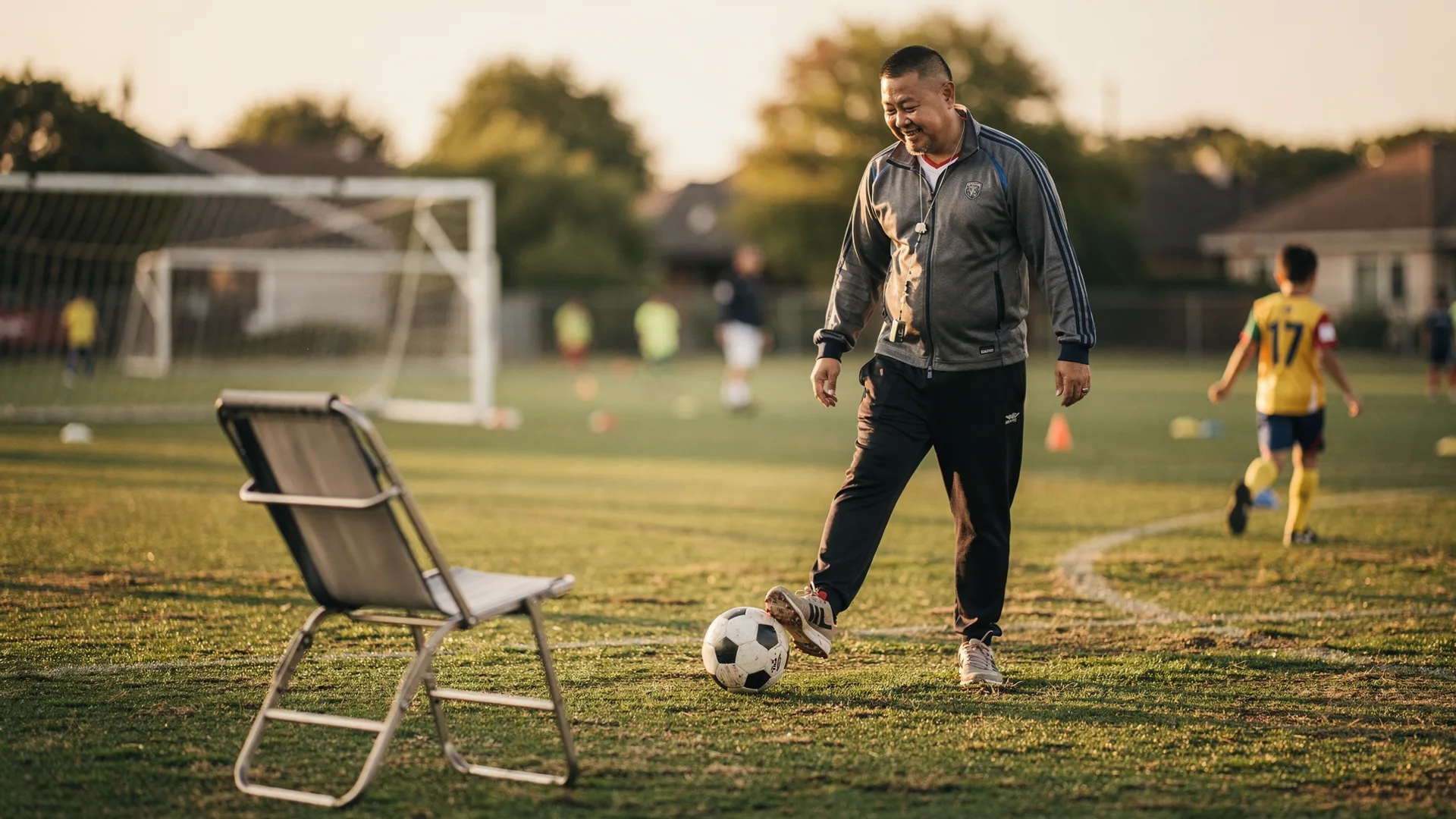
Real shit: the folding chair on the sideline can become a throne of excuses if you sit in it long enough. It starts innocent. You bring the chair because practice runs long and your back is tired. Then you bring it every time. Then you are the dad who is always seated, always shouting encouragement across the grass, always a coach in your own head and a spectator in your kid's actual life. The chair did not do that to you. It just gave you a comfortable place to keep the decision you already made.
Your kid is not grading your athletic ability. Let me say that plainly so you stop hiding behind it. They do not need you to be fast, ripped, or good at the sport. But there is a difference a child feels in their gut between a dad who cannot and a dad who will not. One is a limit. The other is a choice, and kids read choices about them with terrifying accuracy. They may not have the words. They have the feeling.
The backyard invitation you keep declining
It shows up as a small thing. Hey Dad, come play. Kick the ball with me. Race me to the fence. And you have a reflex answer loaded and ready, in a minute, buddy, let me finish this, maybe after dinner, and the minute never comes, and after dinner you are on the couch, and the kid learns not to ask. That is the real cost. Not one skipped game of catch. The slow training of your own child to stop inviting you, because the answer is always a soft no dressed up as a later.
You tell yourself they will not remember. They will. Not the specific afternoons, those blur, but the shape of them. The felt sense of whether Dad got up or stayed down. Kids build their picture of you out of a thousand of these micro-moments, and the picture they are painting while you sit in the chair is of a man who watches from the edge. That is not the picture you want hanging in their head at forty.
The Baseline Audit
Stop guessing what changed.
Ten questions on energy, sleep, weight, libido, recovery, stress, and goals — about three minutes. Then use the read to decide what to raise with a qualified clinician.
Take the Baseline AuditKids clock physical absence
Here is the thing nobody warns you about. You can be present in every other way, pay for everything, drive to every practice, never miss a game, and a kid will still register the physical absence as its own category. There is a specific hunger in a child for a parent who will move with them, who will get grass-stained and out of breath and into the actual game. Emotional presence is real and it matters. It does not fully substitute for physical presence. They want both, and they notice which one you keep withholding.
And they are watching how you treat your own body, because you are the first model they get for what a man does with his one physical self. If Dad treats his body like a thing to be managed from a chair, that is the template. If Dad, even a heavier or older or slower Dad, still gets up and plays badly and laughs about it, that is a completely different lesson about what a body is for. You are teaching either way. The only question is what.
Your kid does not need a superhero. They need a dad who gets up.
Energy is a fatherhood asset, not a bonus
Reframe energy for a second. You probably think of your energy as something for you, a nice-to-have, the thing you are always running low on. But your physical energy is one of the most direct assets you bring to your kid's childhood. The dad with gas in the tank is the one who says yes to the driveway game at seven p.m. because he is not completely wrung out. The dad running on fumes is not a bad father, he is an empty one, saying no to things he would love to do, because he genuinely has nothing left to give by the time the kid asks.
So when you work on your sleep, your walking, your strength, you are not being vain. You are refueling the tank that your kid draws from. That is a different motivation than a beach body, and it holds up better on the cold Tuesday nights when nobody feels like moving. You are not doing it to look good. You are doing it so that when your kid says come play, the honest answer can finally be yes instead of a tired later.
Build a body that participates
The bar here is refreshingly low, which is the good news. You do not need to become an athlete. You need to become a participant. That means building enough baseline capacity to get up, get down on the floor, chase, kick, lift a kid onto your shoulders, and last more than four minutes without your body filing a complaint. Strength so you can get off the ground without a groan. Enough wind that a backyard game does not leave you doubled over. Enough energy at the end of the day to say yes.
If your energy or your joints or your weight are getting in the way of that, some of it is worth a real conversation with a clinician rather than just accepting it as the price of aging. But most of the first steps are yours to take, starting tonight, starting with getting out of the chair for one game you would normally have watched. Fold the chair up. Not forever, and not as punishment. Just often enough that your kid stops thinking of you as the dad who is always sitting down.
This article is educational and is not medical advice. If you are dealing with libido changes, ED, blood sugar concerns, hair loss, weight gain, pain, or recovery issues, talk with a qualified clinician before starting any treatment. See our editorial standards.
Byline
Owen Price
Dating & Fatherhood Columnist
Writes about divorced dads, custody weeks, dating apps, intimacy, and the awkward return to being seen.
More from Owen Price →The Second Half Brief
More on fatherhood, weekly.
One raw email a week — no spam, no miracle claims. Or see what the Brief is.
Write to us
Letters from the Bench
Been through a version of this? Reply with your story and we may run it in a future Letters from the Bench feature. Nothing gets published without your explicit permission, and anything we run is anonymized.
Send your story