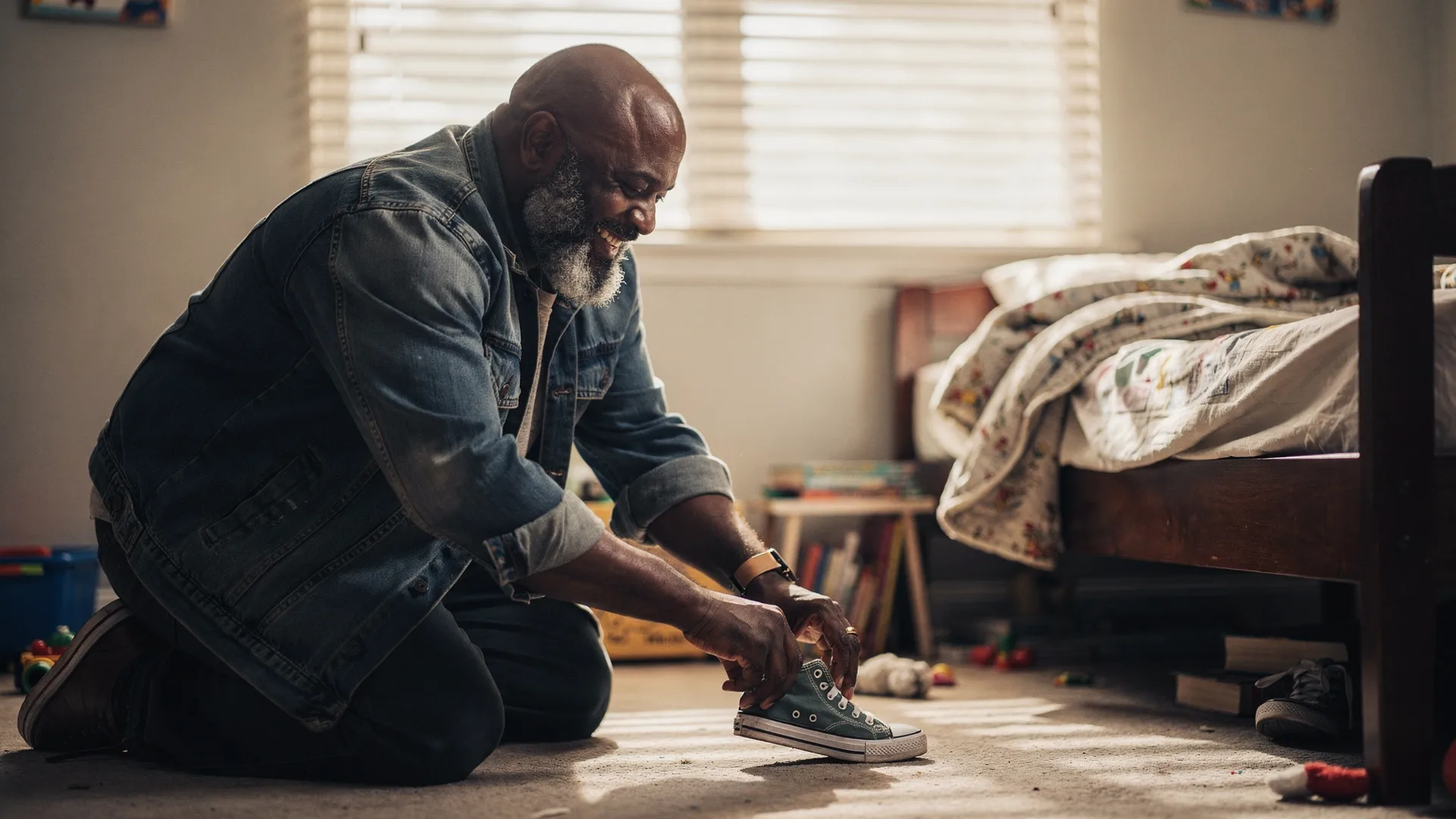
I Want Them to Know Me, Not Just Know About Me
Video calls where the toddler drifts away. Gifts that land like ads. How a long-distance grandfather builds a real relationship in ten minutes a week.
Educational content — see our editorial standards.
 Fatherhood
Real shit: your granddaughter looked at you through the phone screen the way you look at a screensaver — pleasant, moving, not worth focusing on — and then she reached over with one confident little finger and pressed the button that made you disappear. Her mother did the apology-laugh. You did the it's-fine laugh. And then you sat in your kitchen, two time zones away, holding a black rectangle with your own tired reflection in it, doing the kind of thinking a man usually saves for the car.
Because here's the thing you noticed and immediately tried to un-notice: you are excellent at the logistics of being a grandfather. The gifts arrive on time and they are the good ones — you research them like it's your job, because in a way it's the only part of the job you've been given. The birthday card has real handwriting in it. You fly in for the milestones and stand where they tell you to stand for the photo.
And in that house, on an ordinary Tuesday, things arrive from you. You don't.
Say it uglier, since it's just us: you have become a brand in that household. Good packaging. Reliable shipping. Quarterly appearances. A logo she recognizes — that's Grandpa — attached to a person she does not actually know.
The version you say out loud is reasonable and airtight: “Kids that age can't do phone calls. She'll get to know me when she's older.” The version underneath doesn't hold up as well at 2 a.m.: What if older never quite happens? What if the distance is permanent and my body gets less portable every year, and I end up as the man in the frame on their hallway shelf — known about, spoken of warmly, and never once actually missed?
Maybe you know this fear from the other side, which is why it bites so hard. Maybe your own grandfather was exactly this — a voice on a holiday call, a firm handshake twice a year, a man you can describe in three nouns and zero stories. You didn't dislike him. That's the horror of it. There was nothing to dislike. He was upholstery. And you remember, with terrible clarity, the day you realized you felt more when the neighbor's dog died than when he did. You swore, in the vague way men swear things at funerals, that you'd be different. Then life handed you a two-thousand-mile gap and a toddler who hangs up on you, and the default settings started winning.
One more thing about that 2 a.m. fear: it is a demographic, and it gets advertised to. Search anything in the neighborhood of “energy after 60” and the vitality-and-peptide economy will find you by Thursday. The short version now, the long version below: peptide medicine is real in a few specific prescription lanes, and nothing in a vial makes you matter to a three-year-old. If you'd rather get the background from somewhere other than an ad, the current peptide research and lab-documentation landscape is the sane starting point.
That fear makes sense. It just happens to be aimed at the wrong villain.
The milestone model of grandparenting is the real enemy
Somewhere along the line, our whole culture quietly agreed on a model: grandparents show up big and occasionally. Christmas. Graduations. The airport arrival with the suitcase of presents. Love, measured in spectacle, delivered in quarterly installments.
The model flatters everyone and builds nothing. Because a three-year-old does not bond through spectacle. A three-year-old bonds the way water shapes rock: tiny, repeated, predictable contact. Her favorite people are not the ones who bring the biggest boxes. They are the ones who show up on a pattern — the neighbor she sees every morning, the daycare teacher with the song. Frequency is the whole currency at that age, and the milestone model pays in the wrong coin, then tells you the kid is just “too young to connect.”
She's not too young to connect. She's too young for conversation, which is the only thing a standard video call offers her. Those are different problems, and the second one is extremely fixable.
The model has a backup lie ready, too: she'll remember the big trips. She won't — not the early ones, not really. Ask any adult what they actually kept from a grandparent and listen to what comes back. It's almost never the destination. It's the texture: the smell of the workshop, the specific way he answered the phone, the thing he always said. Memory keeps patterns and throws away productions. Which means the expensive weekend you're saving up for is competing against a free Sunday phone call — and losing.
The Baseline Audit
Stop guessing what changed.
Ten questions on energy, sleep, weight, libido, recovery, stress, and goals — about three minutes. Then use the read to decide what to raise with a qualified clinician.
Take the Baseline AuditHow does a long-distance grandparent bond with a toddler? Through short, predictable, repeated ritual — not big occasional gestures. Ten minutes at the same time every week, doing the same silly thing — a song, a puppet, the same book — builds more recognition and attachment in a toddler than an expensive quarterly visit. Frequency and repetition beat spectacle.
The long-distance grandfather playbook: small, weird, weekly
You don't need proximity, youth, or a personality transplant. You need a pattern and a bit. Here's the work.
Claim a standing ten minutes. Text your daughter or son this, more or less: “I want to be more than the guy who sends boxes. Could I get ten minutes with her every Sunday morning, same time, before nap? I'll keep it short, and if you ever need to skip, no guilt — I'll be there next week.” You are asking for a slot, not a favor. Parents can defend a slot.
Do things; don't chat. Buy two copies of the same picture book and read it every single week — same voices, same pause before the page she likes. Show her the garage. Let her give you a tour of the couch. A toddler video call is a show, not a meeting.
Develop a bit and defend it. Be the pancake judge who rates breakfast. Be the hat man who has a different ridiculous hat each week. One repeatable gag that belongs to you and no one else on earth. That bit is your handle in her memory — the thing her hand reaches for.
Send artifacts, not products. A voice memo of you reading a bedtime story, for the nights in between. A photo of you at her age, which will one day detonate wonderfully. A drawing you did badly on purpose so she can do it better. Mail addressed to her is pure theater to a three-year-old, and it costs four dollars.
Make visits ordinary on purpose. Skip one theme park; take her to the grocery store and the puddle on the corner. You're building “grandpa is part of normal life,” not “grandpa is a production.”
Train for the floor. Her world happens at ground level for a few more years. Keep the strength and mobility to get down there and back up, and keep your preventive care current so nothing quietly takes travel off your table. Your legs are relationship infrastructure now. Treat them like it.
Recruit the parent as your producer, not your gatekeeper. Ask your daughter or son what time of day the kid is charming instead of feral, what she's obsessed with this month, which book is currently the law. Parents are drowning in logistics; a grandfather who asks good questions and keeps his slot short is the easiest yes in their week. And say thank you for the ten minutes — the parent is doing invisible stage-managing on their end, every single time.
Six of those cost almost nothing. All of them beat the best gift you've ever shipped.
One warning before you start, because this is where most grandfathers quit: some Sundays will be terrible. She'll be mid-meltdown, or obsessed with the dog, or she'll watch you do the hat bit with the dead eyes of a casting director and wander off camera. You will hang up feeling like a man who told a joke at a funeral. Do not read those calls as verdicts. A toddler's attention is weather, not a review — and the product you're building was never any single call. It's the streak. She is logging the pattern even on the days she ignores it, the same way she'd notice instantly if the daycare teacher stopped singing the song. Show up flat on the bad weeks. The bad weeks are the ones that make it real.
You are not an event. Events end. You are part of normal life — the thing that doesn't.
The peptide question, answered honestly
About that ad — the vial promising the energy of a man twenty years younger so you can “keep up with the grandkids.” The facts: no peptide, approved or investigational, builds connection or restores youth, and the “vitality” compounds sold online carry no approved human use and essentially no rigorous human evidence. Research products are not for self-treatment. Nothing in a vial does what a repeated pancake joke does — that isn't sentiment, it's how attachment works.
If something physical is genuinely blocking participation — fatigue that rest doesn't repay, pain, breathlessness on one flight of stairs — that is a checkable medical problem, and the usual culprits (sleep, mood, medications, heart and metabolic conditions, plain deconditioning) are all more fixable than the internet's version of aging. That one belongs to a clinician. The rest of this problem belongs to a calendar: strength, sleep, and ten minutes every Sunday with her name on them.
Here's eighteen months from now, if you run the playbook. The phone rings in their house on Sunday and a four-year-old shouts your bit before anyone answers — the hat man! — and comes running with her own hat, because now she prepares too. She drags the phone around the room to show you a tower, a scab, the dog. And when you finally come through the front door in person, she doesn't do the shy thing behind her mother's leg. She takes your hand at the door like you were there on Tuesday.
Because at her frequency, you were.
Sources
- Loneliness and Social Isolation — National Institute on Aging
- Physical Activity for Older Adults — CDC
- Fatigue — MedlinePlus (NIH)
This article is educational and is not medical advice. If you are dealing with libido changes, ED, blood sugar concerns, hair loss, weight gain, pain, or recovery issues, talk with a qualified clinician before starting any treatment. See our editorial standards.
Byline
Brooks Vale
Culture Editor
Writes sharp essays about masculinity, status, loneliness, money, confidence, and the second-half identity crisis.
More from Brooks Vale →The Second Half Brief
More on fatherhood, weekly.
One raw email a week — no spam, no miracle claims. Or see what the Brief is.
Write to us
Letters from the Bench
Been through a version of this? Reply with your story and we may run it in a future Letters from the Bench feature. Nothing gets published without your explicit permission, and anything we run is anonymized.
Send your story